
The Humanoid side
Three documented Humanoid features matter for ragdolls:
BreakJointsOnDeath— true by default. When the Humanoid enters the Dead state, its joints break, which is why characters fall to pieces on death in a plain Roblox game. Ragdoll systems usually set it to false and handle death themselves, so limbs stay connected but loose.PlatformStand— puts the character in a free-falling state where it cannot move. Roblox describes it as similar to sitting, except that jumping does not free the Humanoid. Many ragdoll toggles set it while the character is limp.HumanoidStateType.Ragdoll— an engine state, with aRagdollevent that fires when the Humanoid enters or leaves it. Useful for reacting to a ragdoll that physics started, such as a hard fall.
The joint side: Motor6D to BallSocketConstraint
Animations move a character by changing its Motor6D joints. Those joints are rigid: physics cannot bend them. So the standard ragdoll technique is to disable each Motor6D and put a BallSocketConstraint in its place, using two Attachments at the same point on the two parts it used to join.
A BallSocketConstraint lets the parts rotate freely around that point. Left alone, that produces limbs that spin in ways real joints cannot, so most systems turn on LimitsEnabled and set an upper angle (how far the limb can swing away) and, with TwistLimitsEnabled, how far it can twist. Shoulders get wide cones; knees and elbows get narrow ones. To undo the ragdoll, the system re-enables the Motor6Ds and removes or disables the constraints.
Two extras show up in almost every robust system: NoCollisionConstraints between neighbouring limbs, so an upper arm does not fight the torso it is attached to, and a decision about network ownership — which machine simulates the ragdoll — so it does not stutter for other players.
Where the physics lives in a real game
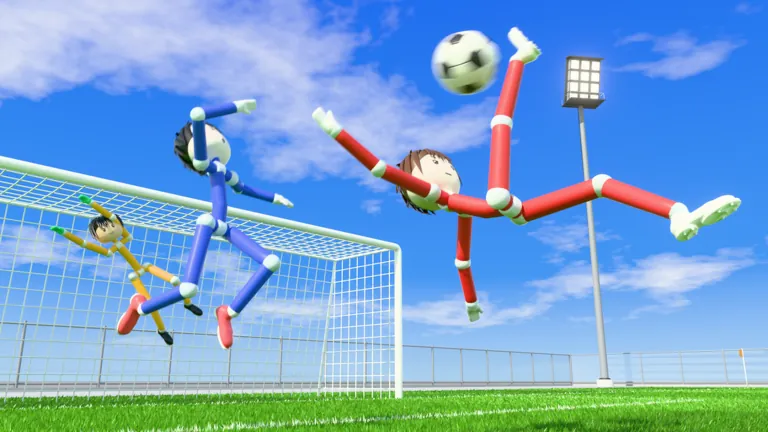
Every game on our list of ragdoll games runs on these pieces. Sports games such as Ragdoll Soccer keep characters limp all the time and let collisions do the work; dummy sandboxes ragdoll non-player models; fighters switch between animated and limp states on a knockdown. The make-a-ragdoll guide turns this into steps.
FAQ
What is a ragdoll in Roblox?
A character whose animated Motor6D joints are replaced (or disabled) so that constraints and physics move the limbs instead.
Should BreakJointsOnDeath be true or false for ragdolls?
Usually false, so limbs stay attached by your constraints instead of falling off when the Humanoid dies.
What is the difference between PlatformStand and the Ragdoll state?
PlatformStand is a property you set to stop the character controlling itself; the Ragdoll state is an engine state with an event you can listen to.
Why do my ragdoll limbs spin wildly?
The BallSocketConstraints probably have no limits. Turn on LimitsEnabled and TwistLimitsEnabled and set angles per joint.
Sources
- Roblox Creator Hub: Humanoid class reference — checked 20 Nov 2026
- Roblox Creator Hub: BallSocketConstraint — checked 20 Nov 2026
- DevForum: RagdollService, all-in-one ragdoll module (community) — checked 20 Nov 2026
How numbers and codes are collected: methodology.